On this page
Lot traceability for process manufacturers, from pre‑weigh to packaging
Lot traceability is the record of where every raw-material lot went: into which batch, and out under which finished lot.
Procense records each raw-material lot at pre-weigh and carries it through compounding, filling and packaging to the finished lot. The trail is complete before an auditor or a customer asks for it.
It runs alongside the ERP you already use and goes live in under 30 days, with no new PLCs and no MES project.







Why Procense
What plants get from Procense
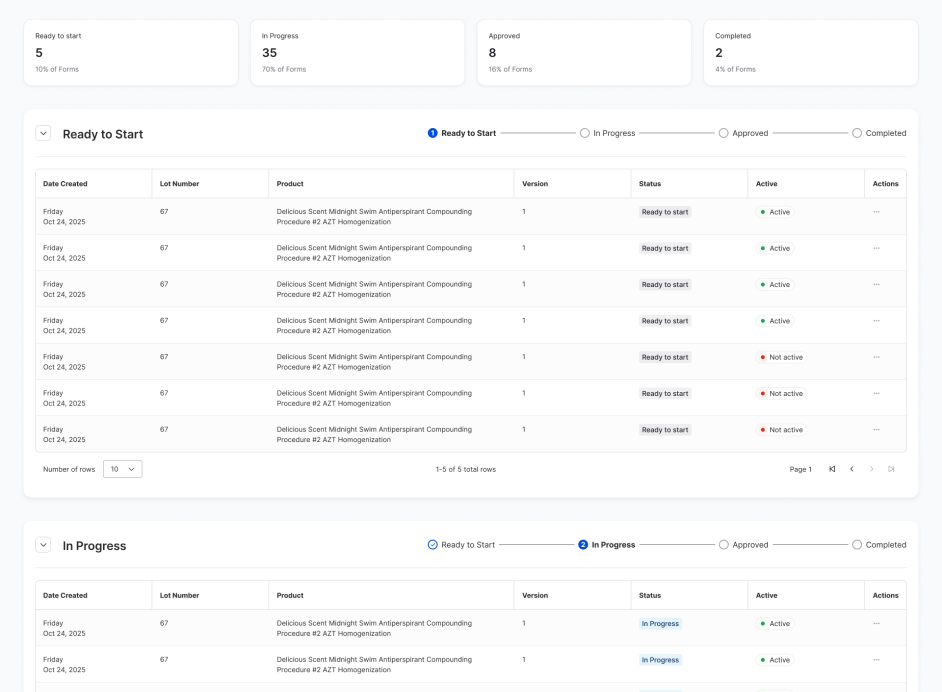
Every lot is recorded at the step where it moves, so nobody re-keys lot numbers from a paper tag at the end of the shift.
Recorded at the step
Operators enter each lot on tablet-ready forms that autofill and flag errors in real time, at pre-weigh, compounding, filling and packaging.
Back to your ERP
Procense writes actual weights, lot numbers, cycle times and yields to the ERP you run, such as Deacom, Datacor, SAP or NetSuite.
Ready for audits
Built for 21 CFR Part 11 and GMP, lot records carry audit trails, user-tied e-signatures and controlled changes.
The platform
Pre-weigh to packaging, one lot record
Each lot moves through three steps on one record. For the wider system, see the manufacturing execution system page and the hardware Procense uses on the floor.
Pre-weigh
Each raw-material lot is recorded when it is weighed.
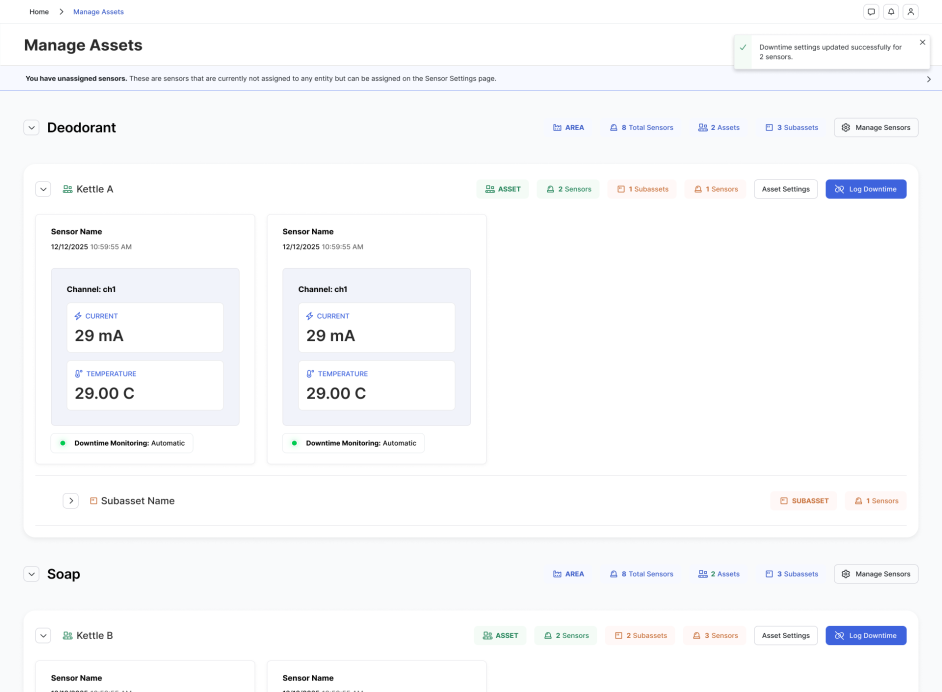
Procense devices read the scales and load cells you already have, so the weight comes from the scale.
The form flags a wrong entry before the batch moves on.
Each device installs in minutes over Wi-Fi or 5G.
The weight and the lot number land on the same line of the batch record.
Compounding and filling
The lot carries into the compounding step it feeds, then into the filling run.
Nobody retypes the lot number at each stage.
Every entry is signed by the person who made it.
Your existing PDF and Excel batch sheets become digital forms in about a minute.
Corrections and QC retests are logged against the same lot.

Packaging and review
Packaging closes the record with the finished lot number.
AI agents review the batch record by exception, so QA checks only the steps that need attention.
The finished lot ties back to every raw-material lot behind it.
Deviations and out-of-spec results are flagged on the record as they happen.
Procense writes the finished lot, its yield and its weights back to your ERP.
Key results
Proof from a personal care plant
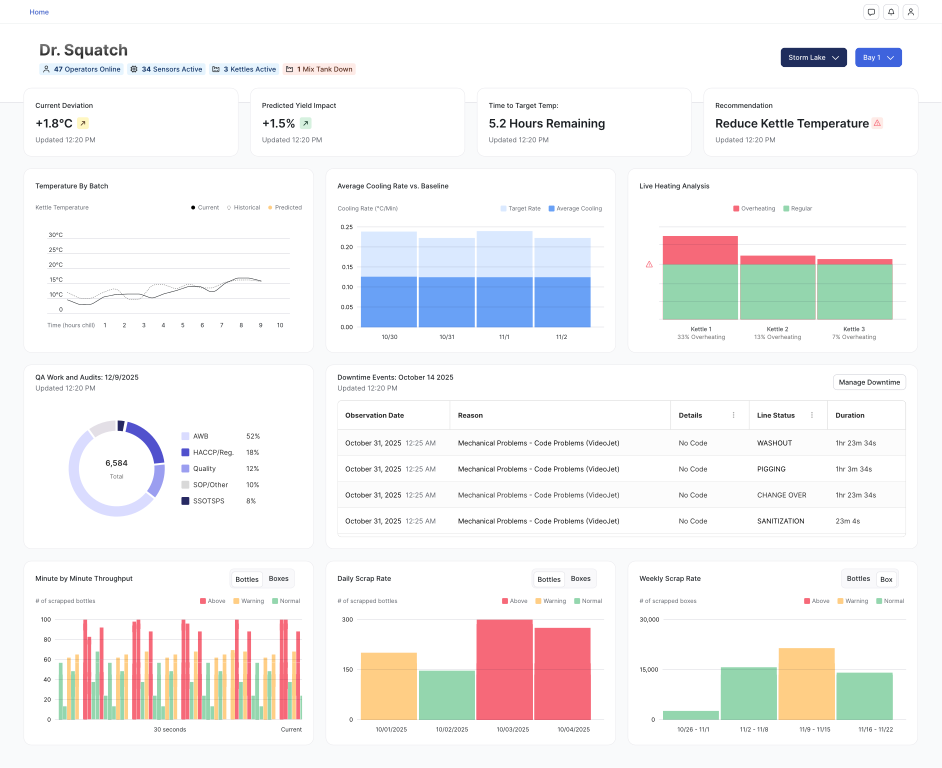
On the Dr. Squatch floor, batch forms run on Procense tablets. The Dr. Squatch case study reports 100% automated traceability and better audit readiness as a result.
Minimizing errors and added traceability are two of the biggest benefits of Procense.

Arvin Amiran
Head of Quality
Who it's for
Built for three regulated industries
Each industry asks something different of its lot records.
Chemical manufacturers
Trace a batch down to the lot.
Each batch links to the raw-material lots that fed it, so a quality issue or an off-spec batch traces back to a specific lot.
Personal care manufacturers
Know which finished lots each raw material reached.
Each raw-material lot ties to the finished lots it went into, so a quality issue or a recall request starts from a complete record.
Nutraceutical manufacturers
Batch records that name every component lot.
Under 21 CFR Part 111, batch production records must name every component lot. Weights and signatures are checked at the step, as the record is built.
Batch records
Start with the lot record
Begin with pre-weigh and the batch record on one line or one facility, keep your ERP, and add scheduling or AI agents when you are ready.

The basics
What is lot traceability
Lot traceability in manufacturing is the ability to follow a lot of material through production in both directions. For dietary supplements, 21 CFR 111.260 sets out what the batch record has to show.
Backward traceability runs from a finished lot to every raw-material lot behind it.
Forward traceability runs from a raw-material lot to every finished lot it reached, which is how a plant limits a recall to the lots that need it.
A complete lot record holds four things tied to one batch:
- The raw-material lots used at pre-weigh
- The compounding and batching data for that run
- The filling and packaging data
- The finished lot number the product ships under
When any of those lives on a separate paper form or spreadsheet tab, the record is no longer complete, and tracing one lot means pulling documents from several places.
Buyer's checklist
What to look for in a lot tracking system
Lot tracking and traceability break in the same places: paper, Excel and PDF batch records, re-keying between the scale and the ERP, and handwritten tags on totes and drums. A lot tracking system for a small or mid-sized plant should close those gaps.
Capture at the step
Lot control and traceability start at the scale. The lot number is recorded when material is weighed, charged, filled or packed, instead of being copied from a tag later.
Lots vs. batches
A batch is one run of the process. A lot is a quantity under one number, such as a supplier's raw-material lot or a finished lot. One batch can fill several finished lots.
Rule-ready records
A supplement batch production record must identify each component, packaging and label used. The system should build that record as the batch runs.
Works with your ERP
It should run alongside your current ERP and go live without a long IT project, so a small plant gets complete lot records without an MES rollout or new PLCs.
Before and after
Point tools, suites or Procense
How paper records and a full MES suite compare with Procense.
Paper and spreadsheets, with lot tags re-keyed by hand
Lots captured at each step and written to your ERP
A full MES suite after months of IT work
Live in under 30 days, alongside the ERP you run
FAQ
Frequently asked questions
What is lot traceability?
Lot traceability is the ability to follow a lot of material through production in both directions: back from a finished lot to the raw-material lots in it, and forward from a raw-material lot to every finished lot it reached. It depends on recording the lot number at each step of the batch.
How is a lot number different from a batch number?
A batch number identifies one run of the process, such as one kettle or one blend. A lot number identifies a quantity of material: a raw-material lot from a supplier, or the finished lot a batch is packed under. One batch can be packed into several finished lots, and many plants use the same number for both. Lot number traceability works the same way whichever number a plant uses.
How do you trace a lot forward and backward?
To trace backward, start from the finished lot and pull the batch record behind it, which lists each raw-material lot weighed at pre-weigh. To trace forward, start from a raw-material lot and find every batch that used it, then every finished lot those batches filled. With Procense, both directions come from one record, since each lot is captured at the step where it moves.
What does 21 CFR Part 111 require for lot records?
Part 111 sets the current good manufacturing practice rules for dietary supplements. Section 111.260 requires the batch production record to include the lot number of the finished batch and of each packaged lot made from it, the unique identifier assigned to each component, packaging and label used, the weight or measure of each component, and the initials of the people who weighed, added and verified each one.
Does MoCRA affect lot traceability for cosmetics?
MoCRA gave FDA the authority to order a cosmetic recall when a company does not recall a product voluntarily. A plant that knows which finished lots each raw-material lot reached can limit a recall to the affected lots.
Do you need an MES for lot traceability?
No. Many process plants get full lot traceability by recording lots on the floor and passing them to the ERP they already run. Procense sends each lot to that ERP as the batch runs, so a new ERP isn't needed either.